

Executive Summary
A major institutional push is underway to develop nuclear energy across BRICS nations and the broader Global South. This effort operates through two overlapping but distinct channels: China’s Belt and Road Initiative nuclear export strategy, and the newly established BRICS Nuclear Energy Platform — a multilateral initiative led primarily by Russia’s Rosatom. Together, these channels are creating a parallel nuclear architecture outside the traditional Western-led order, with profound implications for global energy markets, nonproliferation governance, and geopolitical alignment.
This report examines the origins, structure, key players, active projects, financing mechanisms, and strategic significance of the BRICS nuclear cooperation drive. It draws on verified data from peer-reviewed academic journals, institutional analyses from CSIS and the Wilson Center, reporting from Reuters and World Nuclear News, and official communications from Rosatom, CNNC, and the IAEA.
1. The BRICS Nuclear Energy Platform
1.1 Origins and Launch
The BRICS Nuclear Energy Platform was formally proposed at the BRICS+ Business Forum in October 2024, ahead of the 16th BRICS Summit in Kazan, Russia. Rosatom Director General Alexey Likhachev proposed creating what he described as a voluntary alliance of companies, professional nuclear communities, and NGOs to promote the development and implementation of nuclear technologies across BRICS markets. The initiative received unanimous backing from representatives of member states present at the Moscow Atom Museum, where the foundational meeting took place.
Nine organisations from BRICS member and partner states signed founding statements supporting the Platform’s creation. These included Russia’s Rosatom, China’s CNNC (China National Nuclear Corporation), South Africa’s NECSA and Eskom Holdings, Brazil’s ABDAN (the national nuclear industry association), Iran’s NPPD (Nuclear Power Production and Development Company), Egypt’s NPPA (Nuclear Power Plants Authority), Ethiopia’s Ministry of Innovation and Technology, and Bolivia’s ABEN (Agencia Boliviana de Energía Nuclear). The Platform’s Chief Coordinator is Elsie Pule of South Africa — a significant choice indicating the initiative aims to position African and Global South nations as central stakeholders rather than passive recipients of technology.
1.2 Institutional Development: 2024–2026
The Platform has moved with remarkable speed from proposal to functioning institution. In early 2025, the first expert session was held in China, bringing together representatives from China, Russia, Brazil, South Africa, Iran, the ASEAN Energy Center, and the World Nuclear Association. The discussion focused on new approaches to nuclear energy resource distribution, industry trends, and prospects for cooperation among participating countries. A second expert session followed in May 2025 at the Nuclear Trade & Technology Exchange conference in Brazil.
The most significant institutional milestone came in September 2025, when the annual conference of the BRICS Nuclear Energy Platform was held in Moscow as part of World Atomic Week (WAW-2025). Attended by heads of companies and organisations from Brazil, Vietnam, Egypt, Iran, China, South Africa, the UAE, Ethiopia, Turkey, and the ASEAN Energy Centre, the conference approved the Platform’s first strategic document — a concept paper defining key areas of work. These focus areas include human resources development and workforce training, fundraising and financing mechanisms for nuclear energy projects, supply chain sustainability, promotion of reactor construction and nuclear fuel cycle technologies, public acceptance of nuclear energy, and knowledge transfer among BRICS members. The conference also heard addresses from IAEA Deputy Director General Mikhail Chudakov and World Nuclear Association Director General Sama Bilbao y León.
Most recently, in March 2026, China and Brazil joined the pledge launched at COP28 to triple global nuclear energy capacity between 2020 and 2050, announced at the Nuclear Energy Summit in Paris. This brought the total number of endorsing nations to 38, adding substantial weight to the tripling ambition.
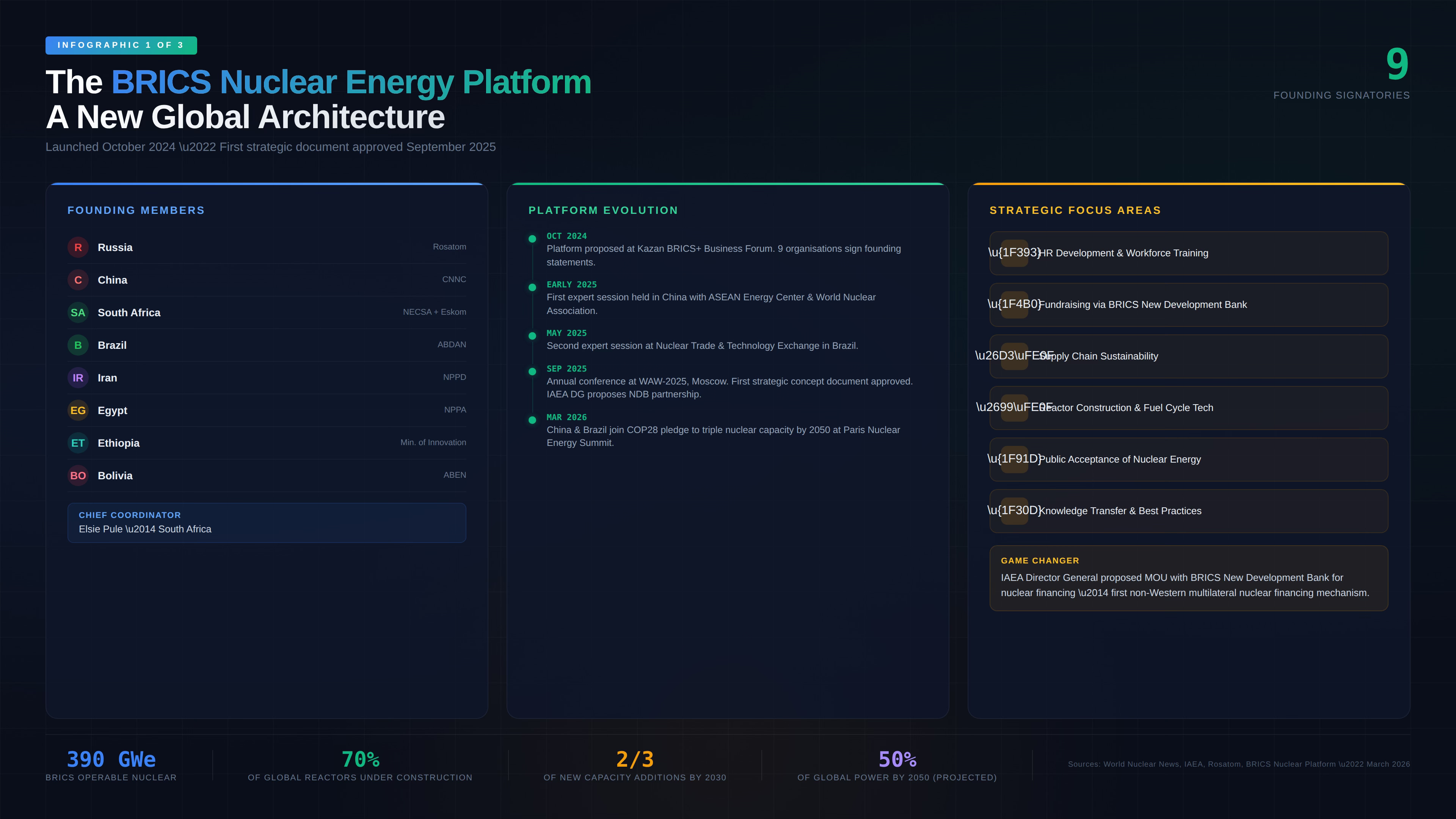
Figure 1: The BRICS Nuclear Energy Platform — Founding Members, Timeline, and Strategic Focus Areas
Listen to this episode with a 7-day free trial
Subscribe to Uranium Unleashed to listen to this post and get 7 days of free access to the full post archives.


